Laydown lays PDF pages out for printing — two-up on A3, a saddle-stitched booklet, a sheet of labels — so they come out right after they're printed, folded and cut. Free, open source, and it runs on your machine.
Windows · macOS · Linux — v0.4.5 · AGPL-3.0 · nothing uploaded, no account
The details that decide whether a job comes back right.
Your pages are embedded as vectors, never re-rendered into pictures. What comes off the press is exactly as crisp as what you put in — text is still text.
If your PDF has a trim box and bleed, Laydown uses them: it places the finished page and carries your bleed past the cut line. Ordinary PDFs with no boxes work fine too.
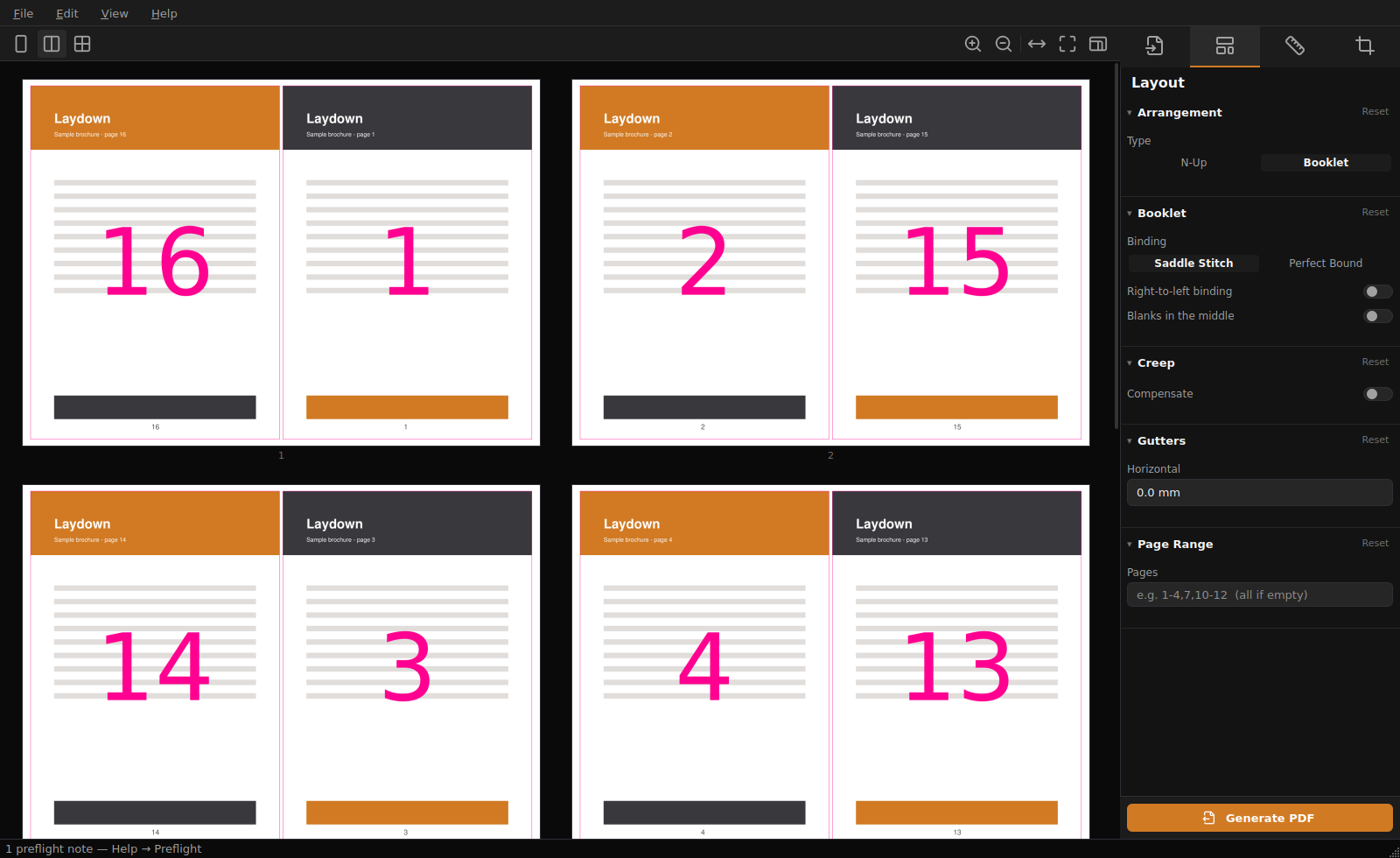
What you see is rendered from a real imposition, and the pink outlines are the cut lines that run actually used. It can't show you one thing and print another.
Margins that don't fit, a missing trim box, pages quietly being shrunk — Laydown says so while you can still fix it, instead of letting you find out at the guillotine.
Saddle stitch or perfect binding with signatures. Page order is worked out for you, and creep compensation evens up the margins on thicker booklets.
Crop, gap crop, registration, fold, perforation, collating marks and a colour bar. Need your own bull's-eye or house colour bar? Point it at a PDF and it gets stamped on.
Open, choose, check, generate.
Open your PDF. Drag it onto the window, or Ctrl+O.
Pick your sheet. Size, how many pages go on it, marks and bleed.
Check the preview. That's your printed sheet — the pink outlines are where it gets cut.
Generate PDF. Send it to the printer.
Free, no account, no strings. Everything's included — no Python needed.
10 / 11 · 64-bit · installer or portable
Get the installerPortable ZIP also on the releases page
The Windows and macOS builds aren't code-signed yet, so the first launch shows a "publisher unknown" warning — on Windows that's More info → Run anyway. Signing costs money and isn't there yet. You can always read the source or build it yourself.
No. There's no network code in it at all. It opens your file, writes a new one, and that's the whole story.
No, and there's no paid tier. It's AGPL-3.0 — free to use, study and modify.
No. Pages are placed as vectors rather than rasterised, so the output matches the source exactly.
Nest folded sheets inside each other and the inner pages stick out further at the open edge. Trimming the stack flush takes more off them, so their margins end up narrower. Creep compensation nudges the pages to even that out. On a thin booklet you can ignore it.
Not yet. That's a press technique where both forms go on one plate, and getting it subtly wrong wastes plates and paper — so it stays out until someone who runs a press has checked it.